
The shock of higher interest rates is no longer the central issue. The more consequential question is whether the economy is fully healing the wounds of inflation or beginning to lose ground as geopolitical conflict, energy-market disruption, fiscal pressure, and policy choices reinforce price and financing-cost pressures.
The continuing unrest in the Middle East and the Russia-Ukraine war illustrate how external shocks and policy responses can complicate the path back to price stability. Against that backdrop, the relevant risk-management question is not simply whether current yields are historically unusual, but whether rates could move another 200 basis points higher over the next nine months if these conditions remain unresolved or worsen.
This is a stress scenario, not a forecast, but it warrants explicit testing of borrower debt-service capacity, refinancing proceeds, collateral values, liquidity, earnings, and capital resilience.
ANALYTICAL NOTES
Understanding the Current Rate Environment
- Economic resilience remains part of the interest rate story. Stronger activity can support earnings and borrower cash flow, while also reducing the urgency for rapid monetary easing.
- Current yields should be judged against a longer history. The post-2008 period featured unusually low policy rates and large-scale monetary accommodation. Market participants may therefore view the low-rate era as the exception rather than the baseline.
- “Financial repression” is a characterization, not a neutral technical label. In this context, the term refers to policies that held rates and bond yields below levels that might otherwise have prevailed. The quotation reflects Morrison’s market interpretation.
- Normalization does not eliminate risk. Even if yields are historically familiar, the transition from low-rate underwriting assumptions can pressure debt service, refinancing proceeds, capitalization rates, and collateral values.
RISK MANAGEMENT
Implications for Banks and CRE Stress Testing
- Higher-for-longer assumptions should remain visible in repricing and maturity analyses, particularly for floating-rate loans, adjustable-rate facilities, and fixed-rate loans approaching maturity.
- Debt-service coverage should be recalculated using achievable refinancing terms rather than assuming a return to the near-zero-rate environment.
- Collateral analysis should separate the effect of higher debt cost from cap-rate repricing and NOI pressure so that the source of migration is transparent.
- Board reporting should distinguish historical normalization from borrower-level affordability. A rate may be historically ordinary while still creating material stress for loans originated or refinanced during the ultra-low-rate period.
FOLLOW THE DATA
Federal Debt-Service Cost: 2021 to Present
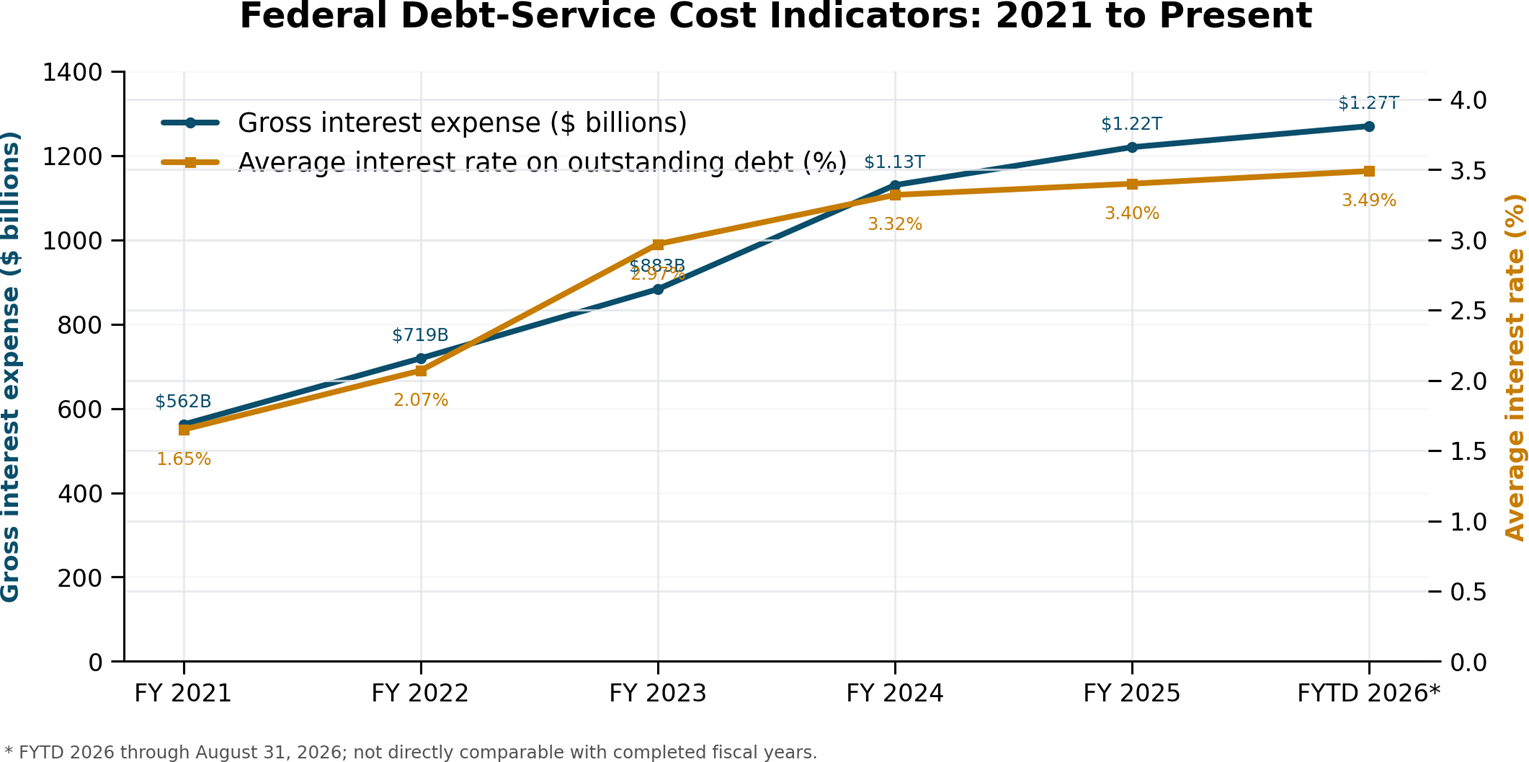
Figure 1. Gross federal interest expense and the average interest rate on outstanding federal debt. The two lines use separate axes. FYTD 2026 is cumulative through August 31, 2026 and should not be compared mechanically with completed fiscal years.
WHAT THE GRAPH SHOWS
The chart illustrates two related but distinct components of federal debt-service cost: the amount of interest paid and the average rate carried by outstanding Treasury securities. Treasury notes that interest expense cannot be derived by simply multiplying the average rate by total debt because the debt stock includes securities with different structures, maturities, and issuance rates. The 2026 point is a fiscal-year-to-date observation, not a full-year forecast.
MARKET PERSPECTIVE
Market Perspective
Market strategist David Morrison argues that the rise in Treasury yields should be viewed in historical context. In his assessment, current yields have largely returned to levels observed before the Great Financial Crisis, while the years that followed were marked by extraordinary Federal Reserve accommodation. That framing suggests that today’s market may represent a normalization of financing conditions rather than an historically extreme rate environment.
For banks and commercial real estate lenders, however, historical context does not lessen near-term credit sensitivity. Loans originated, renewed, or valued during the ultra-low-rate period may face higher debt-service requirements, reduced refinancing proceeds, and greater pressure on debt-service coverage. These effects may be amplified when higher capitalization rates or weaker net operating income place concurrent pressure on collateral values.
The federal government’s own debt-service trend reinforces the broader financing-cost issue. Gross interest expense and the average rate on outstanding federal debt have both risen materially since 2021. The relationship is not one-for-one because the debt stock reprices over time and includes securities issued across varying maturities and rates.
Accordingly, stress testing should continue to assess borrower performance under sustained elevated-rate assumptions and clearly separate the effects of interest expense, NOI pressure, and collateral repricing. A further 200-basis-point increase over nine months should be treated as a severe sensitivity case rather than a forecast.
SOURCES AND DATA NOTES
- U.S. Treasury Fiscal Data, “Interest Expense and Average Interest Rates on the National Debt,” updated August 31, 2026.
- Federal Reserve Bank of St. Louis FRED, “Federal government current expenditures: Interest payments,” U.S. Bureau of Economic Analysis series A091RC1Q027SBEA.
- Yahoo Finance, “10-year Treasury yield hits highest level since 2007,” September 15, 2026, for the quoted statement attributed to David Morrison.
- OECD Economic Outlook, Volume 2026 Issue 1, for analysis of Middle East energy disruptions, inflation, and global growth scenarios.
- The 200-basis-point nine-month case is presented as a CEIS stress scenario, not a prediction of Federal Reserve policy.
- All percentage references are rounded to one decimal place in the narrative where applicable; graph rate labels are shown to two decimals to preserve the source-series presentation.
ABOUT THE AUTHOR
Dean Giglio
Dean P. Giglio
Managing Director, Stress Testing
CEIS Review Inc.
75 Broad Street, Suite 800, New York, NY 10004
Direct: 646.756.1004 | Toll Free: 888.967.7380 | Main: 212.967.7380
Email: [email protected]